Why Organic Nitrogen is Quietly Driving Your Power Bill
In wastewater treatment, there are a handful of parameters operators watch like hawks: BOD, TSS, ammonia, dissolved oxygen. But there is one major driver of cost and energy use that is often underestimated or flat-out ignored until it starts hurting the budget.
That parameter is TKN.
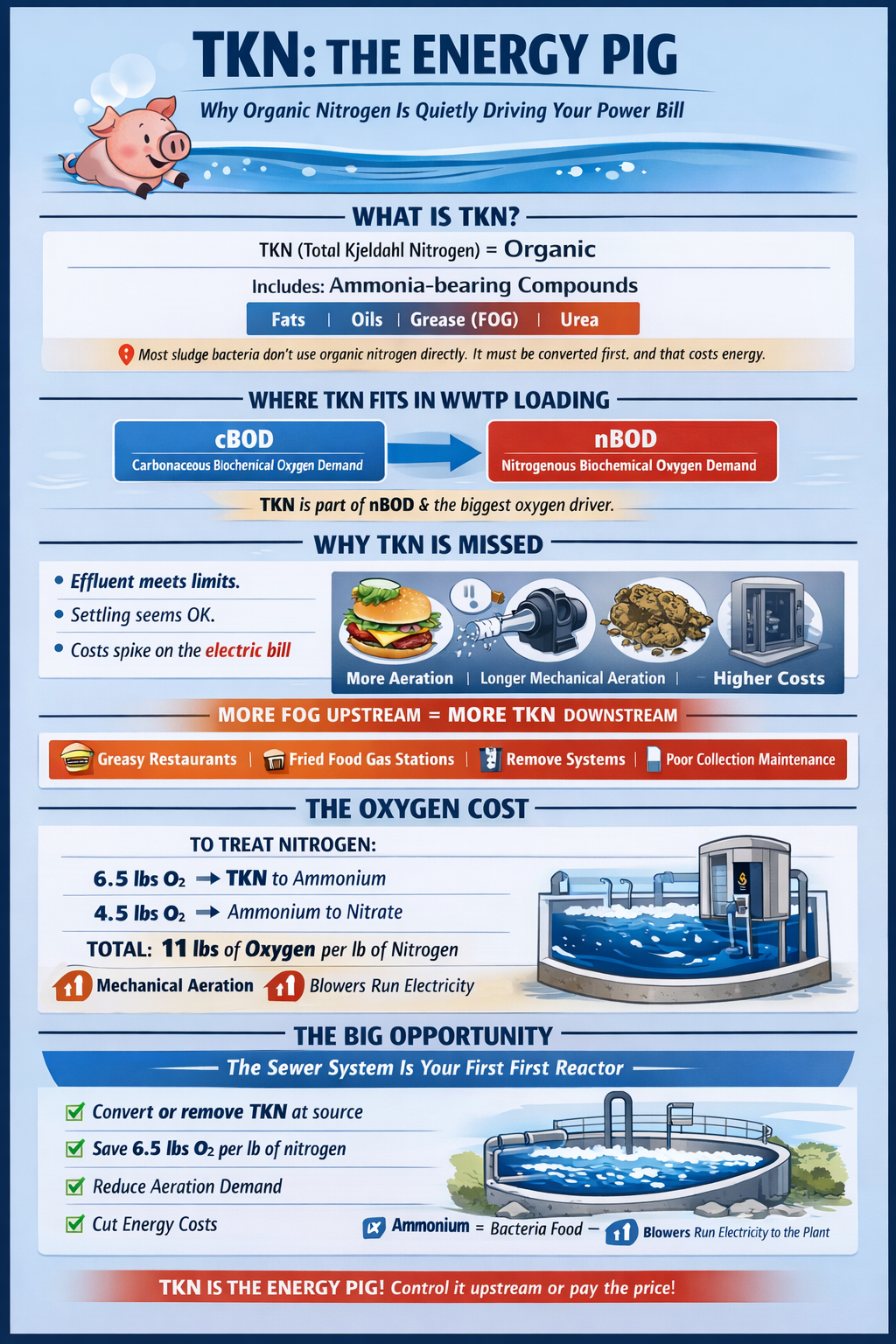
TKN stands for Total Kjeldahl Nitrogen, and it represents organic nitrogen in the wastewater stream. While it does not always get the same attention as ammonia or nitrate, TKN is one of the most significant hidden loads coming into a wastewater treatment plant.
It is an energy hog.
Understanding Where TKN Fits
From a loading perspective, wastewater treatment plants deal with two broad categories of demand:
cBOD – carbonaceous biochemical oxygen demand
nBOD – nitrogenous biochemical oxygen demand
TKN sits squarely in the nBOD category. Most bacteria in the activated sludge process prefer inorganic nitrogen sources such as ammonium, nitrite, or nitrate. TKN, however, is organic nitrogen that must be biologically converted before it becomes usable to the biomass. That conversion costs oxygen. And oxygen costs money.
Why TKN Is Often Overlooked
Many operators do not see TKN as a primary loading concern because its impact is not always obvious at first glance. Effluent numbers may look fine. Settling may appear acceptable. But behind the scenes, TKN quietly drives:
-Increased sludge production
-Higher aeration demand
-Elevated power consumption
-Larger blower runtimes
When plants struggle to control energy costs or cannot explain why aeration systems are running harder than expected, TKN is often a major part of the answer.
What Makes Up TKN
TKN is not a single substance. It includes a range of organic nitrogen sources, including:
-Fats, oils, and greases (FOG)
-Urea
-Other organic nitrogen compounds
This is why TKN is so closely tied to:
-Restaurant grease traps
-Lift stations
-Food service facilities
-Gas stations with fried food operations
When grease trap maintenance is neglected or lift stations are not routinely cleaned, the organic nitrogen load heading to the plant can increase dramatically. The result is a downstream energy problem that shows up on the electric bill.
The Real Cost of Oxygen
Here is where TKN earns its nickname as the energy pig. To biologically process nitrogen, oxygen is required at every step:
6.5 pounds of oxygen are required to convert TKN to ammonium. Another 4.5 pounds of oxygen are required to convert ammonium to nitrate. That is 11 pounds of oxygen per pound of nitrogen moved through the full conversion process. That oxygen does not appear for free. It is generated by blowers and aeration equipment that are powered by electricity. When TKN enters the plant untreated, the blowers spin harder, longer, and more often. That is real money leaving the building.
The Sewer System Is Your First Reactor
Here is the key insight that many plants miss. If TKN can be converted to ammonium before it reaches the treatment plant, the process becomes significantly less expensive. Under anaerobic or low-oxygen conditions in the collection system, organic nitrogen can be converted upstream. When that happens, the plant avoids the 6.5 pounds of oxygen required for the initial TKN-to-ammonium conversion. Ammonium is already a preferred bacterial food source, and the aeration system can focus on nitrification rather than doing double duty.
In short: Convert nitrogen early, and you save energy later.
Where Operators Can Make a Difference
The good news is that controlling TKN does not require new blowers or major capital upgrades. It requires attention to the right places.
-Aggressive grease trap inspection and enforcement
-Routine lift station cleaning
-Focused maintenance on known high-strength contributors
-Proactive management of food service and FOG sources
When these areas are addressed consistently, the reduction in organic nitrogen loading can be substantial.
Why It Matters
TKN is not just another lab number. It directly impacts:
-Energy consumption
-Sludge handling costs
-Aeration system capacity
-Long-term operating budgets
Plants that ignore TKN often end up paying for it every month in electricity. Plants that manage it upstream gain control over both performance and cost. That is why there is so much to do about TKN. It may be invisible most days, but when it comes to energy,
TKN is the pig at the trough.
Is your system wasting time and eating your budget?